The “Disconnected Supply Chain”: Why Your ERP Isn’t Enough for Transport 🚚
When the ERP Says *Ship*, but No One Knows *How* 📦
Your MIS/ERP can tell you that 10 000 units of product X must leave the plant today. That’s great – the system has consolidated demand, inventory and production plans into a single number. The problem starts the moment that order lands on the logistics desk.
The transportation team now faces a manual “how‑to‑ship” puzzle:
- Which truck size fits the load?
- What is the optimal route to meet delivery windows while respecting driver hours?
- How do we balance back‑hauls, loading dock constraints and carrier capacity?
Because the ERP does not speak the language of routing, load‑building and carrier selection, planners resort to spreadsheets, phone calls and endless email threads. The result is **friction**, **delays** and a **double data entry nightmare** that erodes the value of your investment.
Double Data Entry, The Silent Cost Killer 💸
Every time a planner copies order details from the ERP into a separate TMS or an Excel‑based optimizer, two things happen:
- Human error spikes – mistyped quantities, wrong addresses or missed weight limits become common.
- Time drains – a 30‑minute manual entry for each load multiplies across hundreds of shipments per week, stealing hours from strategic work.
Industry surveys show that up to 40 % of logistics teams still rely on manual hand‑offs, costing manufacturers an average of **5–7 % of total freight spend** in hidden rework and detention fees. The fragmented data also means the “single source of truth” lives only in the ERP, while the operations floor works off a stale copy.
Why Integration Matters, The Single Source of Truth 📊
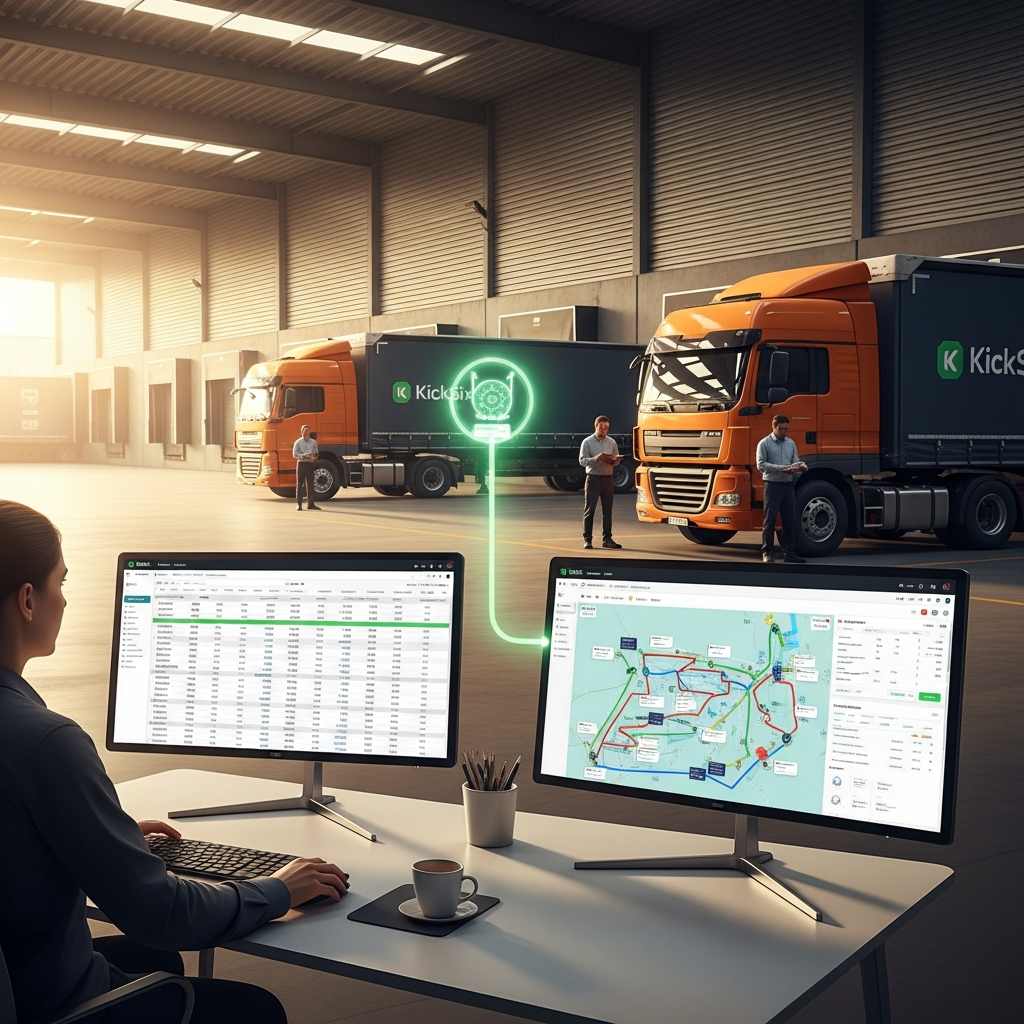
A seamless bridge between MIS/ERP and transport planning eliminates the gap. Here’s how it should work:
- **Demand flows directly into the optimizer** – as soon as the ERP creates a shipment, the optimizer receives product weight, volume, delivery windows and any special handling instructions.
- **The optimizer crunches constraints** (truck capacity, driver hours, carrier rates, loading sequence) and returns an optimal load plan in seconds.
- **Results flow back to the ERP** – the final load‑list, route, carrier assignment and expected ETA are stored in the same system that generated the demand.
When every stakeholder reads from this **single source of truth**, you get:
- Real‑time visibility for production, finance and customer service.
- Zero duplicate entry – data lives once, not twice.
- Faster decision cycles; a planner can re‑run the optimizer on the fly when a carrier cancels or a dock is closed.
KickSix’s Seamless MIS/ERP Integration, How It Solves the Pain 🎯
| Challenge | Traditional Approach | KickSix Solution |
|---|---|---|
| Data fragmentation | ERP → manual copy → TMS → manual copy back | Bi‑directional API that streams shipments into the optimizer and writes results instantly back to the ERP. |
| Load planning latency | Spreadsheet models, hours of tweaking | AI‑driven load builder evaluates thousands of combos in seconds, delivering the most cost‑effective truck mix. |
| Exception handling | Phone calls & email threads | Real‑time alerts surface when a route deviates; the optimizer re‑routes automatically and updates the ERP. |
| Visibility for stakeholders | Separate dashboards, out‑of‑date reports | Unified control‑tower view that pulls data from ERP, TMS and carrier APIs – one dashboard for CTOs, planners and ops managers. |
The core benefit is a **single source of truth** that lives in your ERP but is enriched with transport intelligence. The result? Lower freight spend, higher on‑time‑in‑full (OTIF) rates and freed‑up analyst time to focus on strategy rather than data wrangling.
Real‑World Impact – What You Can Expect 🚀
- **30 % reduction in manual entry effort** – planners spend minutes, not hours, on load creation.
- **10–15 % lower transportation costs** – optimal truck utilization and carrier selection cut deadhead miles.
- **OTIF improvement of 20‑50 %** – proactive re‑routing eliminates last‑minute delays.
- **Instant KPI updates** – finance sees the true cost of each shipment as soon as it’s booked, enabling accurate profitability reporting.